
JAK-Inhibitors for Atopic Dermatitis

JAK-Inhibitors for Atopic Dermatitis的核心信息是什么?

Prof. Jonathan I. Silverberg The George Washington University School of Medicine and Health Sciences Janus kinase (JAK) inhibitors are a novel class of oral disease-modifying drugs...
Prof. Jonathan I. Silverberg The George Washington University School of Medicine and Health Sciences Janus kinase (JAK) inhibitors are a novel class of oral disease-modifying drugs that curb the immune system and block different anti-inflammatory cytokines. To date, three JAK inhibitors (abrocitinib, upadacitinib and ruxolitinib) have been approved for atopic dermatitis (AD). “Atopic dermati... 本文由Jonathan Silverberg撰写,由EADV主办,属于「拓麦精要」分类。 关键词:EADV、特应性皮炎 、JAK、阿布昔替尼、乌帕替尼。
本文核心问答

Q1: 这篇资讯的核心内容是什么?

Prof. Jonathan I. Silverberg The George Washington University School of Medicine and Health Sciences Janus kinase (JAK) inhibitors are a novel class of oral disease-modifying drugs that curb the immune system and block different anti-inflammatory cytokines. To date, three JAK inhibitors (abrocitinib, upadacitinib and ruxolitinib) have been approved for atopic dermatitis (AD). “Atopic dermati...

Q2: 本文属于哪个学科分类,涉及哪些关键词?

本文属于「拓麦精要」分类,涉及关键词:EADV、特应性皮炎 、JAK、阿布昔替尼、乌帕替尼、芦可替尼,由Jonathan Silverberg撰写,由EADV主办。

Q3: 这篇资讯的发布时间是什么?

本文发布于1697716850,来源为TalkMED拓麦医学资讯平台。

作者学术资质

Jonathan Silverberg,就职于The George Washington University School of Medicine and Health Sciences,所属科室:皮肤性病科,职称:其他。

主办单位:

Prof. Jonathan I. Silverberg

The George Washington University School of Medicine and Health Sciences


Janus kinase (JAK) inhibitors are a novel class of oral disease-modifying drugs that curb the immune system and block different anti-inflammatory cytokines. To date, three JAK inhibitors (abrocitinib, upadacitinib and ruxolitinib) have been approved for atopic dermatitis (AD).

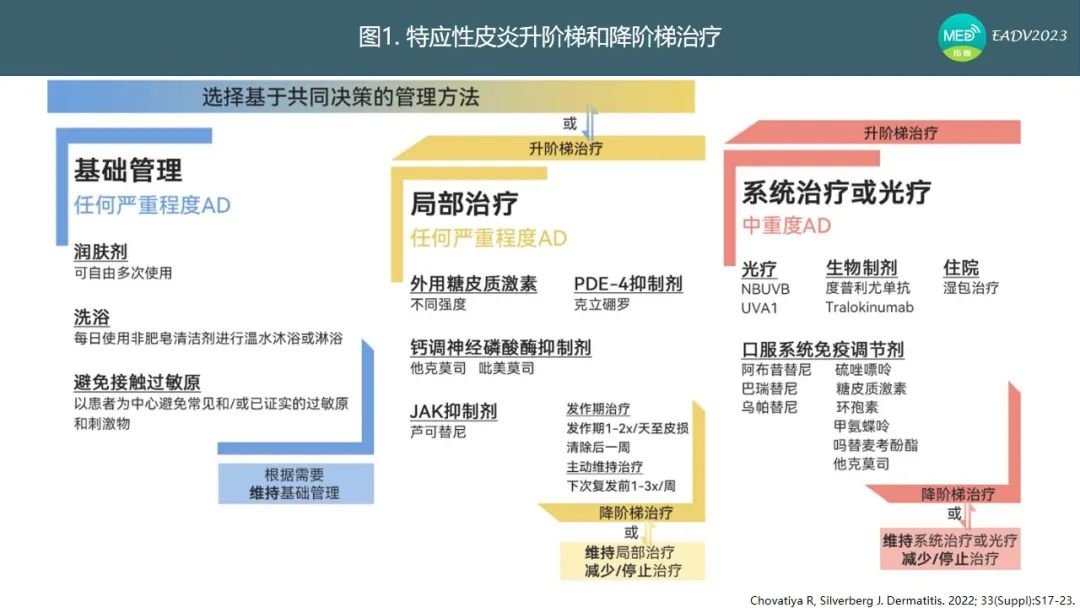
“Atopic dermatitis is not a 16-week disease”, Prof. Dr. Jonathan I. Silverberg, The George Washington University School of Medicine and Health Sciences, Washington, DC (United States), said before addressing AD management (figure 1) and long-term efficacy of novel remedies [1]. Prof. Silverberg explained that JAK inhibitors show preferential activities for certain JAKs over others: Abrocitinib is JAK1 selective with a higher selectivity for JAK1 versus JAK2, TYK2 and JAK 3. The same applies to upadacitinib which also is JAK1 selective. JAK1/2-selective baricitinib has a higher selectivity for JAK1 and JAK2 versus TYK2 and JAK3. Prof. Silverberg was convinced, however, that at high enough concentrations, all these JAK inhibitors would likely inhibit all JAKs.

As there is no “one-size-fits-all” approach, treatment should be personalized to the individual patients and their estimated risks. JAK-inhibitors demonstrated efficacy for itch, pain, sleep disturbance, quality of life, symptoms of anxiety and/or depression in AD patients. Patients, who responded to the oral JAK inhibitors abrocitinib, baricitinib and upadacitinib, showed good long-term maintenance of response with continuous dosing. Abrocitinib and upadacitinib demonstrate overall, comparable safety profiles. Prof. Silverberg said that it is unclear if there are true differences in risk of rare safety events. Possible differences, however, may be more incidences of nausea for abrocitinib and more acne for upadacitinib.

Who is at higher risk for herpes zoster?


Herpes zoster incidence/prevalence was relatively low for baricitinib, abrocitinib and upadacitinib in AD trials (~2%) and comparable with other indications. However, studies excluded patients with disseminated herpes zoster, disseminated herpes simplex, recurrent localized herpes zoster, and a history of eczema herpeticum. Therefore, rates of herpes zoster are expected to be higher if such patients will be treated with JAK inhibitors. Prof. Silverberg suggested considering vaccination for high-risk patients for herpes zoster prior to initiating JAK inhibitor therapy.

 Risk factors for venous thromboembolism with JAK inhibitor therapy


COX-2 inhibitor therapy, prior venous thromboembolism, age above 65 years, obesity, prolonged immobility, prednisone, major surgical interventions, hereditary and acquired thrombophilia are known risks for venous thromboembolism (VTE) with JAK inhibitor therapy. Given concerns about VTE, use of oral contraceptive pills may not be an optimal form of contraception. Therefore, Prof. Silverberg discusses contraception as part of the shared decision-making process with the patient.


Moreover, the speaker suggested to keep an eye on concomitant medication such as COX-2 inhibitors, prednisone, immunosuppressants, and oral contraceptives, vaccination, pregnancy and family planning. Prior to initiation of therapy and every six to 12 months, the speaker suggested checking for cardiovascular risk factors, a history of venous thromboembolism, infections, tuberculosis, risk factors for hepatitis B or C, and malignancies. Physical examination and a skin check for non-melanoma skin cancer are best performed annually.

High response rates


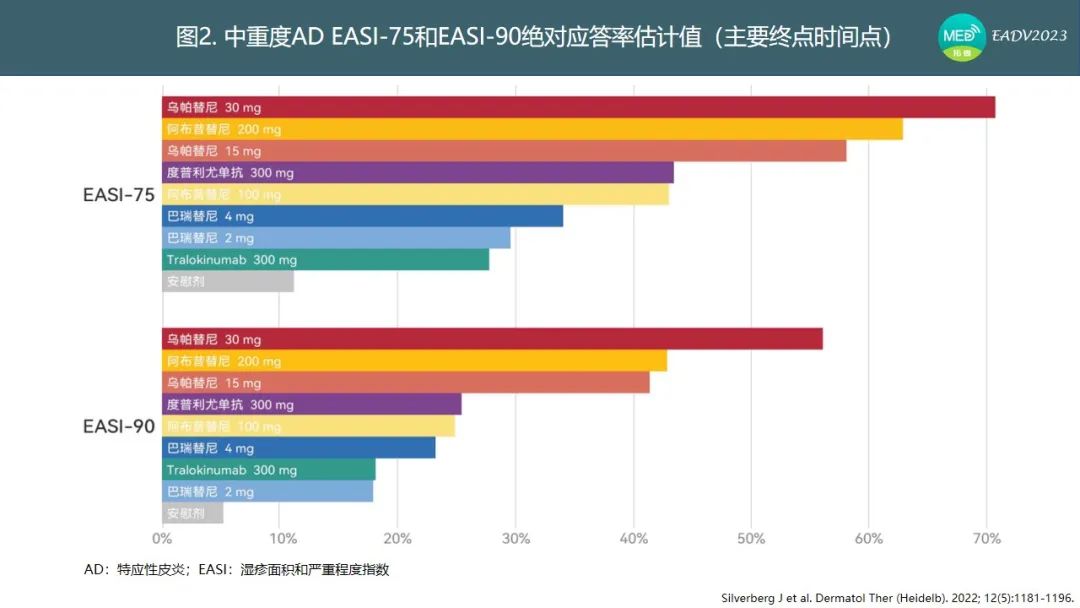
Prof. Silverberg presented his own findings with respect to comparative efficacy of targeted systemic therapies for patients with moderate to severe AD, receiving monotherapy without background topical corticosteroid treatment. The systematic review and network meta-analysis (NMA) ultimately included six records representing nine unique studies, as well as two further upadacitinib trials. Finally, 11 phase-3 placebo-controlled trials, encompassing 6,254 patients in 28 arms across five targeted therapies (abrocitinib, baricitinib, dupilumab, tralokinumab, upadacitinib), were analyzed. The results revealed that upadacitinib (30 mg daily), followed by upadacitinib (15 mg daily) and abrocitinib (200 mg daily) are the most efficacious targeted systemic therapies over 12-16 weeks of therapy in AD (figure 2)

Topical JAK1/2 inhibitors


An approved topical JAK1/2 inhibitor is ruxolitinib (1,5% cream, twice a day) which offers comparable (or even better) efficacy to mid-potency topical corticosteroids without any steroid side-effects. Phase 3 data revealed convincing results across different subsets, trials and populations and very rapid responses on itch as early as 12 hours after the first dose.

Other topical JAK inhibitors in development are delgocitinib and brepocitinib which seem to offer an efficacy comparable to or better than mid-potency topical corticosteroids without any steroid-associated side effects.


1

END

1

Source: Silverberg JI. "JAK inhibitors for atopic dermatitis", Presentation ID D1T13.2, EADV Congress 2023, October 11-14, Berlin, Germany.


引用格式:JAK-Inhibitors for Atopic Dermatitis. 发布日期:1697716850. 来源:TalkMED拓麦. URL: https://portal.talkmed.com/news/532

2023-10-19

分享

收藏

点赞

媒体矩阵
  • 拓麦TalkMED
  • 拓麦精要
  • 拓麦Derm
  • 拓麦Neurol
  • 拓麦Diabetes
  • ONCO前沿
  • 血液前沿
  • 血管资讯
  • MED WIKI
  • 三七二十e
下载桌面应用
苹果应用下载
安卓应用下载