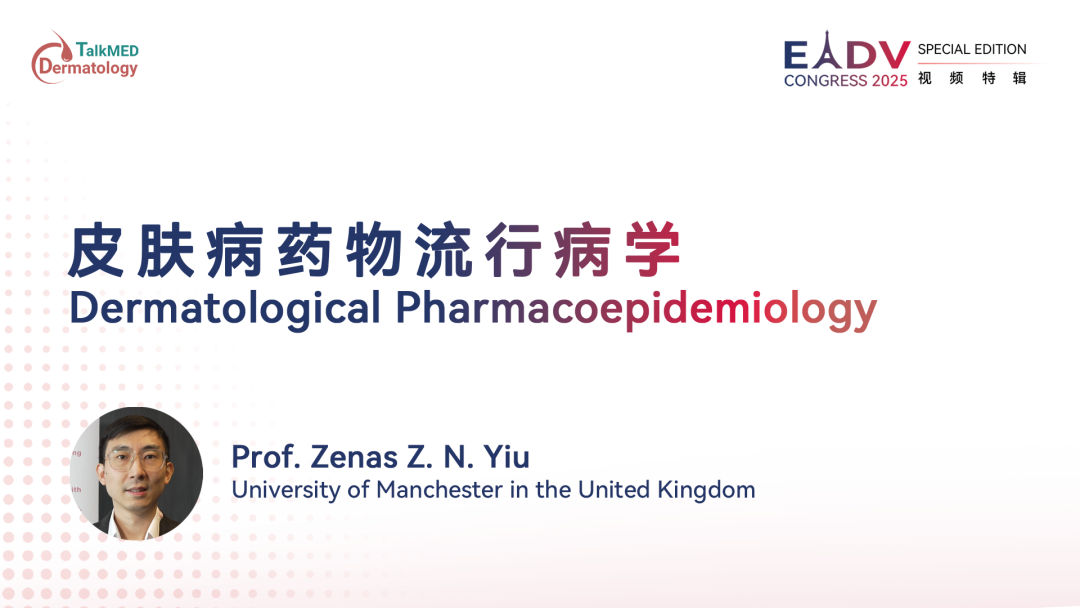
我是Zenas Z. N. Yiu,目前是英国曼彻斯特大学的临床高级讲师,同时担任皮肤科顾问医师,也是药代动力学领域的专家。关于本次EADV会议,它是一场规模宏大的学术会议,涵盖了众多至关重要的议题。接下来,我想首先分享我们团队在此次会议上展示的部分研究成果。
我的博士生John Teta展示了他的首个研究成果,该研究采用孟德尔随机化方法,探究特应性皮炎的发病风险与降脂药物之间的关联。研究发现,根据个体的种族背景不同,服用不同种类的降脂药物可能会导致特应性皮炎发病风险升高或降低。后续,John Teta还计划开展一项基于人群的研究,以尝试对这些数据进行多重验证。
我们团队参与的另一项会议报告来自我的另一名博士生Heba Bright。就在会议当天上午,Heba Bright展示了一组基于英国皮肤科医师协会生物制剂与免疫调节剂登记系统(BADBIR)的数据,该研究为一项队列研究,核心目的是探究不同药物与严重感染风险之间的关联。研究结果显示,随着时间推移,不同药物在严重感染风险上的比较差异可能会发生变化:结合五年的数据来看,大多数生物制剂和全身治疗方案的严重感染风险非常接近(以常用生物制剂阿达木单抗为参照),但部分药物的相关风险相对较高,包括白细胞介素-17A(IL-17A)抑制剂(司库奇尤单抗、依奇珠单抗)以及阿普米司特。研究团队进一步将数据按时间维度拆分为第1年、第2年、第3年、第4年和第5年,发现严重感染风险在不同年份存在差异,且这种差异很可能与临床用药选择逻辑相关——例如,临床中可能会选择本身感染风险较高的患者使用阿普米司特(这类药物被公认为安全性稍高)。目前,该领域仍需更多后续研究,但部分研究结果也验证了已有的认知,即白细胞介素-23(IL-23)抑制剂是安全性较高的治疗选择,其严重感染风险较低。
除了我们团队自身的研究,我还关注到本次会议中部分专科分会场的内容极具学术价值。其中,我参加的一场重要分会场是关于化脓性汗腺炎(HS)的EHSF专场,该专场公布了多项重要研究,包括HS的空间转录组学数据——两组不同的研究团队分别探究了HS的转录组学特征,结果发现,异常表皮形成的特定驱动因素以及推动HS发病的免疫学因素,均在转录组学数据中有所体现,例如Th17细胞通路的重要性,此外浆细胞、B细胞和中性粒细胞也在HS发病过程中起到推动作用。当天上午的其他重要分会场还包括一项有趣的研究,该研究证实抗生素具有抗炎作用,且这种抗炎作用与其抗菌活性相互独立。
最后,我想重点提及两项在HS领域具有重要意义的最新突破性研究(LBA)。其中一项是托法替尼(一种用于HS治疗的JAK1抑制剂)治疗HS的III期随机对照试验(RCT)首次中期分析结果,该结果在本次会议上公布。研究发现,对于主要结局指标“化脓性汗腺炎临床反应50%(HiSCR 50)”,托法替尼的改善率差异约为10%至12%,但在将该结果外推至第24周时仍存在一些不确定性;同时,研究推测该药物的最大疗效可能从第16周开始显现。目前,我们期待能看到该药物完整的III期试验分析结果,若能将这种新的小分子药物加入到当前HS治疗的生物制剂选择中,将为HS临床治疗提供重要补充。
My name is Zenas Z. N. Yiu. I am currently a Clinical Senior Lecturer at the University of Manchester in the United Kingdom, and I also serve as a Consultant Dermatologist as well as an expert in pharmacokinetics. Regarding this EADV Conference, it is a large-scale academic conference that covers a multitude of crucial topics. Next, I would like to first share some of the research findings presented by our team at this conference.
One of my PhD students, John Teta, presented his first research work, which employed Mendelian randomization to investigate the association between the risk of atopic dermatitis and lipid-lowering medications. The study found that depending on an individual's ancestry, taking different types of lipid-lowering medications may lead to an increase or decrease in the risk of atopic dermatitis. Going forward, John Teta plans to conduct a population-based study to attempt triangulating these data.
Another conference presentation contributed by our team came from Heba Bright, another of my PhD students. On the morning of the conference day, Heba Bright presented a set of data based on the British Association of Dermatologists' Biologics and Immunomodulators Registry (BADBIR). This study was a cohort study, with the core objective of exploring the association between different medications and the risk of serious infections. The results showed that over time, the comparative differences in the risk of serious infections among different medications may change: when considering five years of data, the risk of serious infections associated with most biologics and systemic treatments was very similar (with adalimumab, a commonly used biologic, as the reference). However, some medications were associated with a relatively higher risk, including interleukin-17A (IL-17A) inhibitors (secukinumab, ixekizumab) and apremilast. The research team further segmented the data into Year 1, Year 2, Year 3, Year 4, and Year 5 by time period, and found that the risk of serious infections varied across different years. This variation is likely related to the clinical logic of medication selection—for instance, in clinical practice, patients with a inherently higher risk of infection may be selected to use apremilast (a type of medication recognized to have relatively higher safety). At present, more follow-up research is still needed in this field, but some of the study results have also validated existing knowledge: interleukin-23 (IL-23) inhibitors are a relatively safe treatment option, with a low risk of serious infections.
Beyond our team's own research, I also noticed that the content of some subspecialty sessions at this conference was of great academic value. Among them, one important session I attended was the EHSF session on hidradenitis suppurativa (HS). This session presented several key studies, including spatial transcriptomic data on HS. Two different research teams respectively explored the transcriptomic characteristics of HS, and the results showed that specific drivers of abnormal epidermalization and immunologically related pathogenic factors of HS were both reflected in the transcriptomic data. For example, the importance of the Th17 cell pathway was confirmed, and in addition, plasma cells, B cells, and neutrophils also play a promoting role in the pathogenesis of HS. Other important sessions that morning included an interesting study, which confirmed that antibiotics have anti-inflammatory effects, and that these anti-inflammatory effects are independent of their antimicrobial activity.
Finally, I would like to highlight two important late-breaking abstracts (LBAs) of great significance in the field of HS. One of them is the first interim analysis result of the Phase III randomized controlled trial (RCT) of tofacitinib (a JAK1 inhibitor used for the treatment of HS) in the treatment of HS, which was presented at this conference. The study found that for the primary outcome measure ""Hidradenitis Suppurativa Clinical Response 50 (HiSCR 50)"", the delta (improvement rate difference) of tofacitinib was approximately 10% to 12%. However, there were still some uncertainties when extrapolating this result to Week 24; at the same time, the study speculated that the maximum efficacy of this drug may start to appear from Week 16. Currently, we look forward to seeing the complete Phase III trial analysis results of this drug. If this new small-molecule drug can be added to the current biologic options for HS treatment, it will provide an important supplement to the clinical treatment of HS.