成熟药物的长期数据更新
口服JAK抑制剂阿布昔替尼(Abrocitinib)展现了超过六年的长期安全性数据,其安全性特征与1-3年数据高度一致。来自中国的大规模真实世界研究进一步验证了其在临床实践中的有效性与安全性。JADE REAL研究则提供了该药物在上市前使用阶段的剂量管理洞见。
新型作用机制:靶向OX40/OX40L通路
大会也聚焦于靶向OX40/OX40L通路这一新兴作用机制。与当前针对下游细胞因子的疗法不同,该通路作用于免疫应答的更上游,通过调节T细胞与抗原呈递细胞的相互作用,有望实现免疫系统再平衡,可能带来持久的疾病缓解。
lRocatinlimab(OX40受体拮抗剂):作为T细胞导向疗法,旨在清除过度活化的致病性T细胞。数据显示其单药及联合治疗均达到主要终点,其起效可能较慢,但潜在优势在于未来可能实现延长给药间隔甚至停药。
lAmlitelimab(OX40配体拮抗剂):公布了其II期试验的长期安全性数据,结果令人鼓舞,为其III期临床试验提供了有力支持。
临床挑战与精准治疗
针对难治性头颈部AD,会议探讨了生物制剂(如IL-13抑制剂曲罗芦单抗和Lebrikizumab)在此特殊部位的治疗潜力,为传统疗法疗效不佳或使用度普利尤单抗后出现特殊症状群的患者提供了新选择。
疾病拓展:脂溢性皮炎的新疗法
Raj Chovatiya教授还分享了靶向PDE4抑制剂罗氟司特泡沫剂在脂溢性皮炎中的亚组分析结果。该药在不同种族、肤色患者中均显示出显著且一致的疗效,并能有效改善疾病伴随的色素沉着异常。
Raj Chovatiya教授总结,本次EADV大会在AD治疗领域取得了丰硕成果,从成熟药物的长期验证到创新机制的深入探索,预示着AD的治疗格局正迈向更加精准、高效的新阶段。
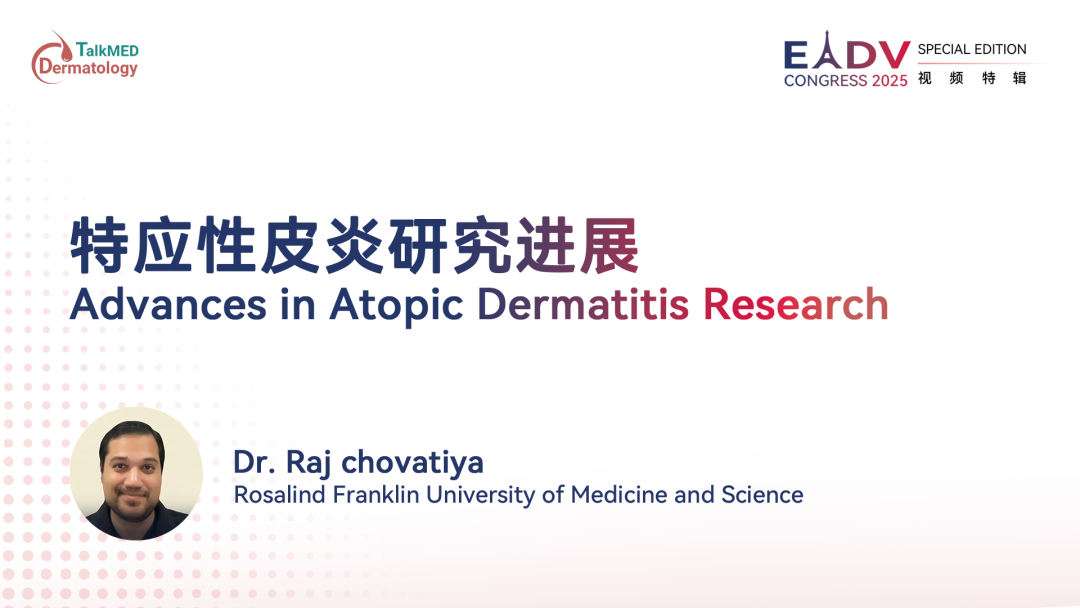
"At the EADV 2025 congress in Paris, Dr. Raj Chovatiya from Rosalind Franklin University in the USA shared key updates in the field of atopic dermatitis (AD).
Long-term Data for Established Therapies
The oral JAK inhibitor, Abrocitinib, demonstrated long-term safety data extending beyond six years, showing high consistency with its 1-3 year profile. Large real-world evidence studies from China further confirmed its efficacy and safety in clinical practice. The JADE REAL study provided insights into dose handling prior to its commercial availability.
Novel Mechanism: Targeting the OX40/OX40L Pathway
A major focus was on the emerging OX40/OX40L pathway. Unlike current therapies targeting downstream cytokines, this pathway acts earlier in the immune response. By modulating the interaction between T cells and antigen-presenting cells, it holds the potential for immune rebalancing and sustained disease modification.
Rocatinlimab (an OX40 receptor blocker): A T-cell directed therapy designed to deplete overactivated pathogenic T cells. Data showed it met primary endpoints both as monotherapy and in combination. While onset may be slower, potential benefits include extended dosing intervals and possibly drug-free remission in the future.
Amlitelimab (an OX40 ligand blocker): Presented long-term safety data from Phase 2 trials, yielding encouraging results that strongly support its ongoing Phase 3 programs.
Addressing Clinical Challenges & Precision Medicine
For difficult-to-treat head and neck AD, the role of biologics, particularly IL-13 blockers like Tralokinumab and Lebrikizumab, was discussed. These agents may offer new options for patients refractory to conventional treatments or those experiencing specific symptom constellations post-Dupilumab.
Disease Expansion: New Therapy for Seborrheic Dermatitis
Dr. Chovatiya also presented an oral presentation on the targeted PDE4 inhibitor, Roflumilast foam. Sub-analyses demonstrated its robust and consistent efficacy across diverse patient races, ethnicities, and Fitzpatrick skin types. Notably, the treatment also effectively improved disease-associated hypo- and hyperpigmentation.
Dr. Chovatiya concluded that this EADV has been highly productive for the AD field, showcasing progress from long-term validation of established drugs to in-depth exploration of novel mechanisms, all pointing towards a more precise and effective future for patient management."