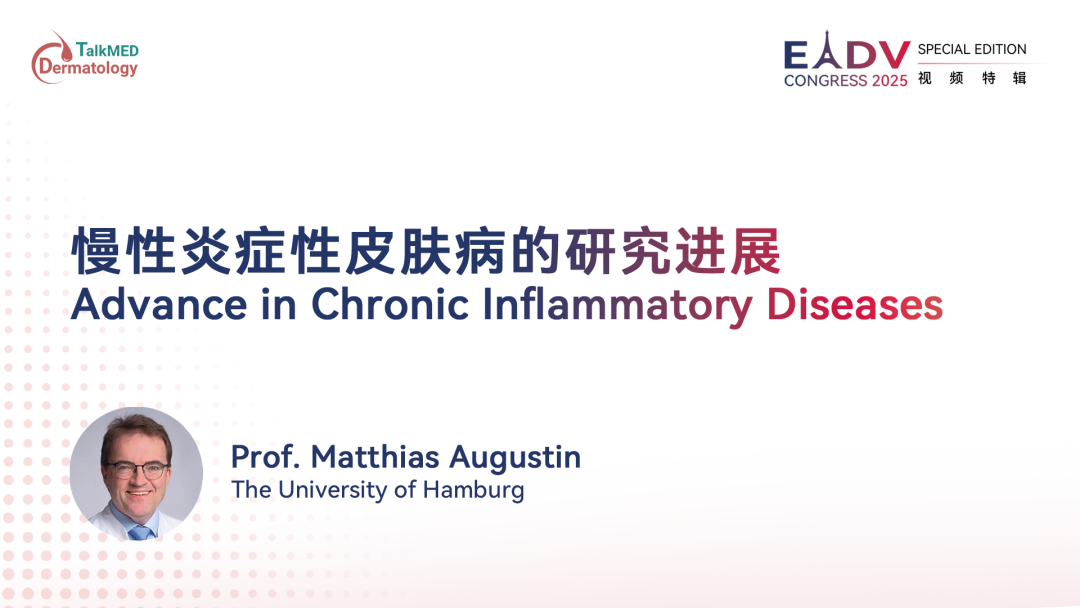
大家好,我是 Matthias Augustin,是一名皮肤病学教授,同时也是德国汉堡大学的卫生经济学教授。事实上我是皮肤科的主任。我很高兴可以快速总结对于 9 月 25 日巴黎 EADV 大会的感想。首先,这是一个盛大的会议,超过 20000 人参加,有非常多的分会场,它的盛大程度难以想象。我的研究领域,也是我特别感兴趣的部分,是关于特应性皮炎、银屑病、其他慢性炎症性疾病以及慢性损伤等等。
首先谈到的是特应性皮炎。当然,这对于所有人来说都很重要,大家肯定也特别感兴趣。根据最新数据,它也是我觉得最有潜力的药物,最近它也进入了医疗保健领域。它就是 nemolizumab,一种 IL-31 抑制剂。遵照临床试验项目,大家可能意识到 nemolizumab 有两种适应证,一种是结节性痒疹(PN),另一种是特应性皮炎。我参加了与这两种适应证相关的研究,我很高兴看到这些数据,包括长期的数据,从长期拓展研究中得出。例如,在我们参与的 ARCADIA 研究中,已经有了明确和积极的结果。对于接受 nemolizumab 治疗的特应性皮炎患者,与外用类固醇治疗相比,Nemolizumab 短期起效的特点在后续的长期扩展研究中也被新的数据所证实。可以说的是,nemolizumab 在特应性皮炎(AD)以及结节性痒疹中都有很好的控制效果。在用药早期,甚至短短几天内,就恢复效果而言,nemolizumab 与外用糖皮质激素已有可比性。基于此,我们也很高兴看到,nemolizumab 用药早期的疗效,无论是瘙痒还是炎症,EASI 评分显示,在第 1 年和第 2 年的后续研究中都是如此。换句话说,有了 nemolizumab,我们就有了第 4 种治疗特应性皮炎的生物制剂,它有强大的疗效。根据首批使用 nemolizumab 的 100 例患者的个人临床经验,可以明确的是,即使患者对 IL-4/IL-13 抑制剂应答不佳,即度普利尤单抗,lebrikizumab 和曲罗芦单抗,就他们的临床应答而言,nemolizumab 凭借其独特的作用机制,仍有很大概率依旧有效。另一方面,我们也看到了比较数据,更长远的结果和真实世界的结果,与其他生物制剂相比,度普利尤单抗的数据可溯时间更长。至于曲罗芦单抗和 lebrikizumab,公平地说,这 4 种生物制剂都有很好的疗效,它们在提高患者生活质量以及改善重度特应性皮炎患者的健康状况方面有着重大贡献。这也是我们在壁报研究和演讲中所展示的来自德国的大规模研究数据。第 2 种选择,当然是 JAK 抑制剂。也有一些新的数据,我参与了其中一部分,是关于乌帕替尼、阿布昔替尼和巴瑞替尼在特应性皮炎中的应用,同样地,通过比较数据和拓展的大量安全性数据。这是大家一开始关心的问题之一,因为有 FDA 的黑框警告、欧洲的相关警告,但我们可以看到,这些警告在很大程度上来源于托法替布在类风湿关节炎中的应用数据,它们不会转移到特应性皮炎领域。目前已经有 3 种 JAK 抑制剂登记在册。换句话说,目前我们有另一种选择,无论是短期还是长期数据,这 3 种 JAK 抑制剂的表现都非常出色。因此,在我所在的德国,根据目前的指南推荐,我们可以使用上述 7 种药物,包括 4 种生物制剂,3 种 JAK 抑制剂用于治疗特应性皮炎,在患者的治疗初期即可使用。因此,如果患者有中重度的特应性皮炎,无需使用其他药物。
现在,让我们简单谈谈银屑病。在银屑病领域,我们拥有更多的药物,我们有更多的经验,更多关于生物制剂的长期数据以及用于银屑病的小分子药物。尽管如此,我们还是得到了一些新的数据,例如 IL-17/IL-23 阻断剂与共病的治疗密切相关,这不仅仅是银屑病关节炎,还包括心血管疾病和代谢方面的共病,这在欧洲是一大难题。因此,我们从登记处的新数据中看到,一旦我们控制了系统炎症,使用 IL-17 和 IL-23 阻断剂,我们也更有可能控制这些疾病,即炎症导致的心血管疾病、代谢性疾病和肥胖症。当然,如果涉及到肥胖症,还存在一个问题,那就是我们如何处理控制体重的药物,如何对待导致体重减轻的 1 型糖尿病(T1D)药物?关于这方面有更多数据,首先有数据显示,在部分患者中,这些药物确实有助于改善临床结局,就银屑病和银屑病关节炎而言。当患者服用这些药物并且体重显著减轻,这也可以通过其他方法来实现,比如胃部手术,或者改变生活方式。这是另一个非常引人注目的领域。
慢性炎症的第 3 大类是化脓性汗腺炎(HS)。目前有新的指南,欧洲指南和建议,推荐意见包括在 HS 中,如果存在炎症部位,应使用多西环素,而不是克林霉素作为起始疗法,这也是可行的。但若经这 3 种生物制剂之一治疗后仍未见效,而它们本可以有效地控制炎症,则需要转换方案。然而,在许多患者中,还需要进行手术,这可以很好地与他们的生物制剂治疗相结合。以上是我想展示的在慢性炎症性疾病的治疗方面有趣且令人振奋的内容。谢谢。
Hello. I'm Prof. Matthias Augustin, professor of dermatology, and also professor of health economics at the University of Hamburg in Germany. I'm actually the director of the dermatology department. It's pleasure for me to quickly summarize what was my experience with the EADV conference in Paris in Sep. 25. First of all, this was a huge congress with more than 20000 participants and very many parallel sessions. Nobody could capture just a tiny part of it. My special interest, because this is my research area, was in atopic dermatitis, psoriasis and other chronic inflammatory diseases, but also in chronic wounds and beyond.
If we start with atopic dermatitis. Of course, this is something which is important to all of us, and you have a surely special interest in this. The most recent data, and the most I feel a promising molecule which has recently come into health care. It's nemolizumab, IL-31inhibitor. You may have followed the clinical trial program, and may be aware of the fact that there have been two indications for nemolizumab. One being prurigo nodularis(PN), the other being atopic dermatitis. I participated in both programs, and I was glad to see the data from this, but also a long term data that, if derived from the long term extension. For example, in the ARCADIA program where we participated, there were already clear and positive outcomes. For the people with the atopic dermatitis treated with nemolizumab compared to just topical treatment with steroids. This short term onset of action also was followed by new data for the long term extension. What I can tell you is that in atopic dermatitis(AD), but also in prurigo nodularis, there's a very good control of each. At the very early time point, even after some days, with nemolizumab compared in recovery comparison to topic steroids. Given this, we were also glad to see that this very early onset of action, both on pruritus and on inflammation, with the EASI score persisted across the 1st and then also the 2nd year in the follow up study. So, in other words, with nemolizumab, we have 4th biological drug for treating atopic dermatitis with a lot of power. From my clinical experience with the first 100 patience on nemolizumab, I can tell you that even if patients have failed to have good responses for the IL-4/IL-13 inhibitors, which is dupilumab, lebrikizumab and tralokinumab, there's a good chance and probability that they still respond to nemolizumab with this unique mode of action. On the other hand, we have also seen comparing data on more long term outcomes and real world outcomes for the other biologics, dupilumab with the long history of data. tralokinumab and lebrikizumab, it's fair to say that all of the four biologicals have a very strong position. They contribute to a lot of a gain in quality of life and patient health in severe atopic dermatitis. This is what we have also shown in a poster and a lecture in large scale data from Germany. The 2nd option, of course, is the JAK inhibitors. There were also new data, some of which I participated in, on the use of upadacitinib, abrocitinib and baricitinib in atopic dermatitis. Again, with comparing data and great number of extra safety data. This was one of the early concerns people had because of the FDA black box warning, and warning also in Europe. But we can see that those warnings, which largely derived from data gained in rheumatoid arthritis on tofacitinib, are not transferable to atopic dermatitis. There are three JAK inhibitors, which have been registered. So in other words, at here we have another option, and the short term, at long term data also for the three JAK and inhibitors are great. So in my country, in Germany, there's the recommendation, by the current guideline, that we make use of those seven substances, four biologics, three JAK inhibitors in treating atopic dermatitis from the very first moment. So there's no need to use any other drug before if there's moderate to severe disease.
Now, let's move briefly to psoriasis. Of course, we have much more drugs available. We have much more experience, many more long term data for the biologics and other also the small molecules in psoriasis. But nevertheless, there were coming some new recent data, which show that the is IL-17/IL-23 blockers, e.g. a very relevant also in treating comorbidity. This is not just psoriatic arthritis, but cardiovascular and metabolic comorbidity, which is a huge problem in Europe. So, we see from very new data from the registries, that once we control the systemic inflammation with IL-17 and IL-23 blockers, we also have a higher probability of controlling these diseases, the inflammation driven cardiovascular diseases, metabolic disease, obesity. Of course, if it comes to obesity, there was also a question, how do we deal with those drugs which control weight and lead to weight reduction T1D drugs? There were some more data, first data on this, showing that in some patients, they really contribute to better also clinical outcomes in terms of psoriasis, psoriatic arthritis. When patients take them and have remarkable reduction in weight, which also can be done by other measures, gastric operation, or just lifestyle changes. This was another area which was really compelling to see.
In the 3rd large area in terms of chronic imflammation was hidradenitis suppurativa(HS). There's a new kind of guideline, European guideline and recommendations, when you should showing that it's recommendable to start treatment in HS if there's inflammatory compleponent, with doxycycline, rather than clindamycin but this would also be possible. But then turn if there's no response to one of the three biologics which lead to a good control of inflammation. Nevertheless, in many of the patients, as you know, there is also the need to do surgery, which can nicely be combined with their biological treatment as well. So this is I want to show what I found interesting and exciting in terms of treating their chronic inflammatory diseases. Thank you.