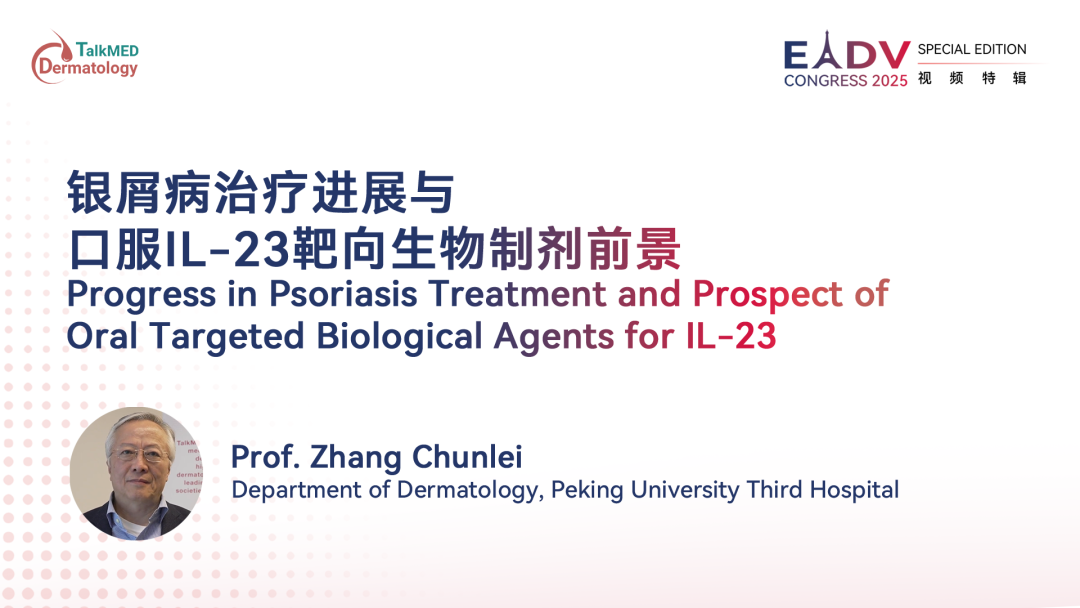
欧洲皮肤病与性病学会年会(EADV)是我们专业领域规模第二大、最具影响力的专业年会之一。我至少参加过 5 次,今年感觉格外特殊,因为我们高度关注皮肤科领域的热点问题,尤其是免疫介导炎症性皮肤病(IMSD)相关议题。
基于中国大陆近几年的临床实践,在近 3000 种皮肤科疾病中,银屑病的靶向生物治疗(包括大分子和小分子药物)是转化最成功的领域之一,还引领了皮肤科治疗理念的革命,比如目标治疗(T2T)、疾病早期拦截(T2I)、早期干预、疾病修饰等。我们前期开展的古塞奇尤单抗相关 Guide 研究,就聚焦于如何实现早期修饰、帮助患者快速获得最佳治疗应答。此外,多学科诊疗(MDT)模式、慢病管理等理念的发展,也让皮肤科与风湿免疫科、消化科、眼科、骨科及精神卫生学科等多个领域实现了整合。
过去按组织器官分类疾病的方式已无法满足临床需求,如今行业内逐渐达成共识,转向基于核心致病细胞因子、炎症因子及相应细胞通路的疾病分类,实现了多病共治、异病同治的统一管理模式,一种药物可解决多疾病、多器官、多系统的问题。
2014年,首个真正意义上的肿瘤坏死因子(TNF)抑制剂依那西普在中国大陆问世,至今约 20 年。而生物制剂在皮肤科领域的真正发展仅五六年时间,却已发生翻天覆地的变化。目前,中国大陆公认的银屑病生物治疗靶点至少有 10 个,医保覆盖的国产生物制剂达数十种,从早年的使用顾虑到如今的选择困难,体现了行业的快速发展,但临床需求仍未完全满足。
大分子生物制剂存在患者畏惧注射、需 2-8℃冷藏保存、免疫原性可能引发注射部位疼痛等不良反应,且患者担忧长期安全性;小分子药物如已获批的 PDE4 抑制剂、TYK2 抑制剂(氘可来昔替尼)及外用 AHR 调节剂,虽具备服用便捷、储存容易的优势,但与 IL-23P19、IL-17A 靶向生物制剂相比,起效慢、银屑病面积和严重程度指数(PASI)应答率较低,与传统系统治疗差异不大,患者对快速起效、更高皮损清除率的需求尚未得到满足。
本次年会上,IL-23 受体拮抗剂口服靶向生物制剂的 2 期、3 期临床试验数据(尤其是最新 3 期数据)令人瞩目。北京大学第三医院参与了该国际多中心试验,且作为单中心入组患者数量最多、贡献最大。该药物解决了现有生物制剂的安全性、免疫原性、储存不便等问题,与氘可来昔替尼、IL-12/IL-23 P40 靶向药物乌司奴单抗的头对头比较中,表现更优或相当。
此外,PDE4 抑制剂阿普米司特与 TYK2 抑制剂氘可来昔替尼已在中国大陆实现国产化并纳入医保,两者的头对头比较结果已在往年年会公布,氘可来昔替尼临床疗效约为阿普米司特的两倍。而这款新型 IL-23 口服靶向药填补了现有治疗的缺口,为银屑病靶向治疗提供了更多选择。
研究发现,IL-23 受体是中国银屑病患者的易感基因,因此该口服靶向生物制剂更适合中国患者。我们期待其能早日在国内外同步上市,满足中国银屑病患者未被满足的治疗需求。
The European Academy of Dermatology and Venereology (EADV) Congress is one of the second-largest and most influential professional annual meetings in our field. I have attended it at least 5 times, and this year feels particularly special because we are highly interested in hot topics in the field of dermatology, especially those related to immune-mediated inflammatory skin diseases (IMSD).
Based on our clinical practice in Mainland China over the past few years, among nearly 3,000 types of dermatological diseases, targeted biologic therapies for psoriasis (including both macromolecular and small-molecular drugs) are currently one of the most successfully translated fields. They have also led a revolution in dermatological treatment concepts, such as Treat-to-Target (T2T), early interception of diseases (T2I), early intervention, and disease modification. Our previous representative Guide study on guselkumab focused on how to achieve early modification and help patients achieve the best and fastest treatment response. In addition, the development of concepts such as the Multidisciplinary Team (MDT) diagnosis and treatment model and chronic disease management has integrated dermatology with rheumatology and immunology, gastroenterology, ophthalmology, orthopedics, and even mental health disciplines.
The past method of classifying diseases by tissues and organs can no longer meet clinical needs. Nowadays, there is a growing consensus in the industry to shift to disease classification based on core pathogenic cytokines, inflammatory factors, and corresponding cellular pathways, realizing a unified management model of treating multiple diseases with one approach and managing different diseases with the same strategy. One drug can address issues affecting multiple diseases, organs, and systems.
Back in 2014, the first true Tumor Necrosis Factor (TNF) inhibitor, etanercept, was launched in Mainland China, which was only about 20 years ago. However, the real development of biologic therapies in the dermatology field has only been around 5 to 6 years, and earth-shaking changes have already taken place. Currently, there are at least 10 recognized biologic therapy targets for psoriasis in Mainland China, with dozens of domestic biologic agents covered by medical insurance. From concerns about use in the early years to the difficulty of choice today, it reflects the rapid development of the industry, but clinical needs are still not fully met.
Macromolecular biologic agents have problems such as patients' fear of injections, the need for storage at 2-8℃, immunogenicity that may cause side effects such as pain at the injection site, and patients' worries about long-term safety. Small-molecular drugs such as approved PDE4 inhibitors, TYK2 inhibitors (deucravacitinib), and topical AHR (Aryl Hydrocarbon Receptor) modulators, although having the advantages of convenient administration and easy storage, compared with biologic agents targeting IL-23p19 and IL-17A, have a slower onset of action, lower Psoriasis Area and Severity Index (PASI) response rates, and little difference from traditional systemic therapies. Patients' needs for fast onset of action and a higher degree of lesion clearance have not been met.
At this annual Congress, the Phase 2 and Phase 3 clinical trial data (especially the latest Phase 3 data) of the oral targeted biologic agent targeting the IL-23 receptor have attracted much attention. Peking University Third Hospital participated in this international multi-center trial, and as a single center, enrolled the largest number of patients and made the greatest contribution. This drug addresses the safety, immunogenicity, and storage inconvenience issues of existing biologic agents, and has shown superior or comparable performance in head-to-head comparisons with deucravacitinib and ustekinumab (a drug targeting IL-12/IL-23 P40).
In addition, the PDE4 inhibitor apremilast and the TYK2 inhibitor deucravacitinib have been localized in Mainland China and included in medical insurance. The results of head-to-head comparisons between the two have been published at previous annual Congresses, with deucravacitinib's clinical efficacy being approximately twice that of apremilast. This new oral IL-23-targeted drug fills the gap in existing treatments and provides more options for the targeted treatment of psoriasis.
Studies have found that the IL-23 receptor is a susceptibility gene for Chinese psoriasis patients, so this oral targeted biologic agent is more suitable for Chinese patients. We look forward to its early simultaneous launch at home and abroad to meet the unmet treatment needs of Chinese psoriasis patients.