我叫 Georgios Kokolakis,至今已有约 18 年从业经历,目前在柏林夏里特医学院皮肤科工作。现在我是那里的研究员,日常既要接诊患者,也要推进自己的研究项目,专业方向是炎症性皮肤病学,重点研究银屑病和化脓性汗腺炎(HS)。
我觉得这次会议非常有意思,不仅因为能接触到最新研究数据,更因为能和同行交流、拓展人脉 —— 在会上能结识很多同行。而且巴黎是个很棒的城市,特别适合举办这类大型会议,这次会议就像皮肤科领域的盛会,既有学术交流,也有社交互动。我在这次大会上展示了多张壁报,下面想介绍其中两个我认为最有意思的研究。
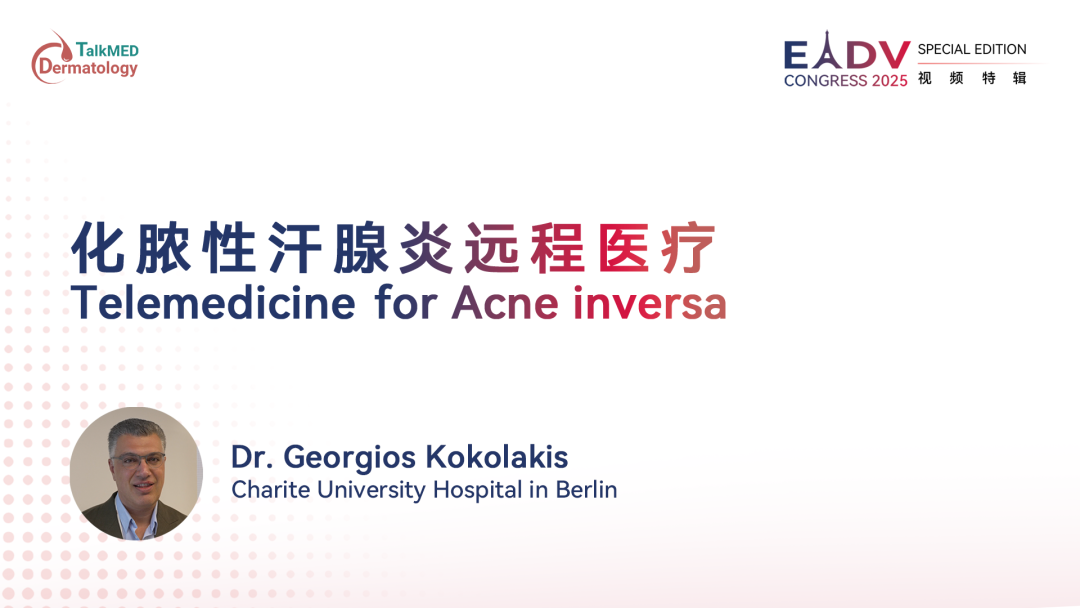
第二张壁报对应的项目名为 “Televersa”,即针对反常性痤疮(德国定义为化脓性汗腺炎 HS)的远程医疗项目。我们将远程医疗与数字医疗技术应用于 HS 患者诊疗,原因是 HS 患者确诊耗时极长;我们希望通过搭载相关算法的 iPad 等数字工具,加快确诊速度。我们收集了约 500 名患者的数据,分析发现患者不愿就医、确诊需长达 10 年的主要原因是自我压抑和羞耻感 —— 患者会因患病而感到难为情。这是研究中的重要发现,且该研究视角与其他疾病的研究有所不同。
此外,我们在该项目中还尝试引入人工智能算法,探究其能否大幅缩短 HS 确诊时间(比如从 10 年缩短至 1 年)。若能实现,我们就能更快为患者提供治疗,避免疾病因延误治疗产生不良影响,但这部分数据将在下一届大会上公布。非常感谢大家。
其实我认为 EADV 大会最有价值的一点是,它是一个高度注重临床应用的大会。大会既涵盖基础研究(如免疫学、转录组学新数据、罕见病等领域),也包含临床研究 —— 我们既能接触基础研究成果,也能看到这些知识在临床实践中的应用。这种 “基础 + 临床” 的结合,正是我们为患者开发新型疗法和药物的关键。值得一提的是,EADV 大会不局限于单一领域,而是将临床实践与实验室研究很好地融合在了一起。
My name is Georgios Kokolakis, and I've been working since about 18 years, now at the clinic of dermatology in the Charite University Hospital in Berlin. I work now as a fellow researcher there and I do my patients my projects as well, so I specialize on inflammatory dermatology, with a focus on psoriasis and HS.
I found this meeting really interesting not only because of the new data but because of the networking of the colleagues that you can meet there, and I think Paris is an exciting city to do such a big meetings, I think it's like a big party for the dermatology not only for the scientific part but also for the social part. I had several posters in this Congress, maybe I can refer to two of them, which I found most interesting.
The second poster is about an interesting project called Televersa, which means telemedicine in acne inversa (defined as hidradenitis suppurativa, HS, in Germany). We combined telemedicine and digital medicine for patients with HS. We did this because HS patients take a long time to get a diagnosis; by using digital tools like an iPad with algorithms, we hope to accelerate diagnosis. We collected data from about 500 patients and found why they don’t go to the doctor and why diagnosis takes up to ten years—mostly due to suppression and embarrassment, as patients feel ashamed of the disease. This is a notable finding and a different approach compared to studies on other diseases.
In this project, we also tried using an AI algorithm to see if it can speed up diagnosis—cutting the time from ten years to maybe one year. This would let us treat patients faster and avoid distracting consequences from the disease, but I will present this data at the next Congress. Thank you very much.
Actually, what I find interesting about EADV is that it’s a very clinically oriented Congress. It includes basic research (like immunology, new transcriptomics data, and rare diseases) as well as clinical research—we get to see both basic knowledge and its application in clinical practice. This combination is how we develop new medications and drugs for patients. What’s great is that EADV covers both sides, not just clinical practice or laboratory research, but a mix of both.