课程介绍
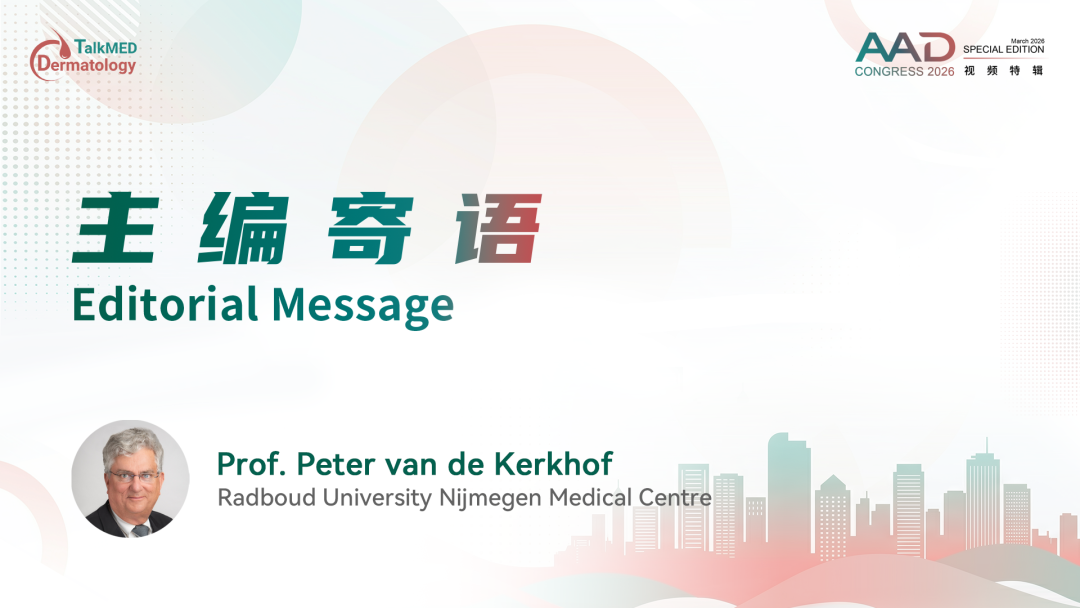
Peter van de Kerkhof 教授任职于拉德堡德大学奈梅亨医学中心,是该中心的皮肤病学教授、高级名誉教授,在该机构担任学术部门主任近 30 年;同时担任国际银屑病委员会首席医疗官,还为皮肤病学学会提供继续医学教育,开展相关顾问工作,并为皮肤病学领域的企业进行专题演讲。
皮肤癌是 AAD 2026 大会的重点关注方向,临床中需做好皮肤癌的早期识别与规范治疗,晚期皮肤癌的药物治疗也取得了重要进展;皮肤癌的预防工作尤为关键,需针对高风险人群开展筛查与早期识别,其中接受长期免疫抑制治疗且有紫外线辐射暴露史的患者是重点筛查对象。
银屑病、化脓性汗腺炎、特应性皮炎以及坏疽性脓皮病等常见与少见的炎症性皮肤病,在靶向治疗领域均取得了新发展,目前各类疾病都已有可直接应用于临床管理的新治疗方法。
新治疗方法的临床应用并非追求快速见效,核心是坚持长期维持治疗与长期诊疗策略;银屑病治疗中总结的早期干预经验可推广至其他皮肤病,对银屑病的早期积极干预,能减少病灶中组织驻留记忆细胞的数量,预防疾病向重症发展,实现长期、真正的疾病修饰;早期诊断、早期干预是所有皮肤病诊疗中需倡导的核心理念,以此实现疾病的长期有效管理。
Prof. Peter van de Kerkhof is a professor and senior professor emeritus in dermatology at Radboud University Nijmegen Medical Centre, and he has chaired the academic department of the centre for nearly 30 years. He also serves as the Chief Medical Officer of the International Psoriasis Council, provides continuing medical education for dermatological societies, undertakes relevant advisory work, and delivers special lectures for enterprises in the dermatology field.
Skin cancer is a key focus of the AAD 2026 Congress. In clinical practice, it is essential to conduct early identification and standardized treatment of skin cancer, and important progress has been made in the drug treatment of advanced skin cancer. The prevention of skin cancer is particularly crucial, and screening and early identification should be carried out for high-risk groups, especially patients receiving long-term immunosuppressive treatment with a history of ultraviolet radiation exposure.
New developments have been achieved in the field of targeted therapy for both common and rare inflammatory skin diseases such as psoriasis, hidradenitis suppurativa, atopic dermatitis and pyoderma gangrenosum. At present, new therapeutic methods applicable to clinical management are available for all these diseases.
The clinical application of new therapeutic methods is not for immediate effects, but the core is to adhere to long-term maintenance treatment and a long-term diagnosis and treatment strategy. The experience of early intervention summarized in the treatment of psoriasis can be extended to other skin diseases. Early active intervention for psoriasis can reduce the number of tissue-resident memory cells in lesions, prevent the progression of the disease to a severe stage, and achieve long-term and genuine disease modification. Early diagnosis and early intervention are the core concepts to be advocated in the diagnosis and treatment of all skin diseases, so as to realize the long-term and effective management of diseases.