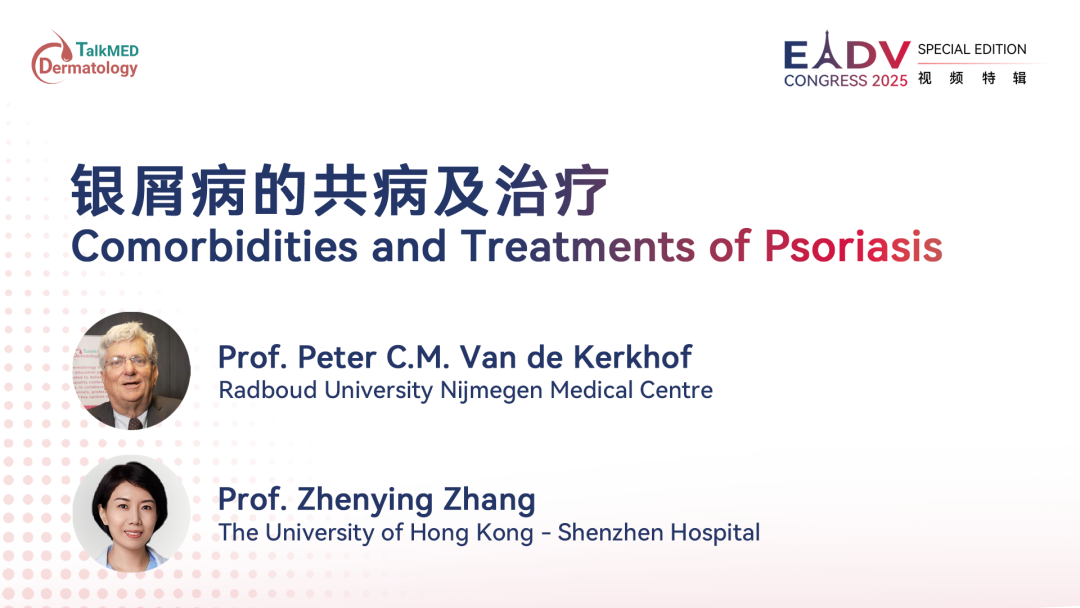
亲爱的同仁们,很高兴能在 2025 年欧洲皮肤病与性病学会(EADV)会议特辑上开启此次对话。也非常荣幸能与张振颖(Lisa Zhang)教授一同参与此次交流。我是 Peter C.M. Van de Kerkhof,一名来自拉德堡德大学奈梅亨医学中心的皮肤科高级教授,主要研究方向为银屑病。我在皮肤科领域从事教学工作已近 40 年,培养了众多初级医师成长为合格的皮肤科专科医师,同时还参与银屑病及角质形成细胞异常相关疾病的研究工作。我们目前正在 EADV 会议现场,Lisa,能否向各位同仁介绍一下您自己及您的研究方向?
感谢 Peter 教授。非常荣幸受邀参加此次会议。我是张振颖医生,来自香港大学深圳医院。我从事皮肤科临床工作已超过 20 年,主要研究方向为银屑病及炎症性皮肤病。在日常工作中,我会开展临床试验,并围绕银屑病的发病机制进行一些基础研究。这就是我的自我介绍,谢谢大家。
非常好,我们此刻一同身处 EADV 会议现场,这里有众多不同领域的学术报告,我认为我们也能从这些感兴趣的领域报告中汲取很多知识。能通过这个栏目与中国皮肤科医生分享这些学习成果,我感到非常荣幸。Lisa,或许我们可以先聚焦一个重要话题,深入探讨银屑病的共病问题,首先从银屑病关节炎开始。我们都知道银屑病可能合并银屑病关节炎,问题在于皮肤科医生应如何助力银屑病关节炎的早期诊断?张教授,您对此有何看法?此外,通过治疗银屑病来预防银屑病关节炎的发生,这种思路是否具有临床意义?
好的,关于第一个问题,我们先从银屑病关节炎(PsA)说起。我院皮肤科数据显示,约 20% 的银屑病患者会发展为银屑病关节炎,这一比例很高,是个不容忽视的数字,因此我们必须高度关注这一患者群体。其次,心血管系统共病也较为严重,心肌受累和脑卒中是银屑病患者的主要死亡原因,我们同样需要密切监测这部分患者的心血管健康。第三,代谢综合征是另一类重要共病,影响人群广泛,包括合并高血压、高脂血症或胰岛素抵抗的患者,肥胖也是我国患者日常管理中的一个突出问题。
事实上,皮肤病学已从仅关注皮肤疾病的学科,发展为兼顾皮肤病与共病关联的学科。当银屑病关节炎完全发展并满足所有诊断标准时,我们可能已错失最佳干预时机,此时关节可能已出现损伤。当然,与风湿免疫科医生的协作至关重要,但实际挑战在于:在疾病早期,患者可能仅主诉关节疼痛或乏力,我们怀疑存在银屑病关节炎的早期迹象,却无法明确诊断,此时皮肤科医生能发挥怎样的作用?
是的,我曾就这一问题与风湿免疫科医生交流过。遗憾的是,目前尚无明确的生物标志物可用于预测银屑病关节炎的发生,我希望能有这样的标志物帮助我们早期识别高危患者。例如,合并甲银屑病、头皮银屑病或肥胖的患者,发展为银屑病关节炎的风险更高。当你遇到这样的患者时,是否会更加留意银屑病关节炎的可能?我通常会让患者填写问卷,以此来评估关节症状。
这是个很好的方法,保持警惕确实有助于早期发现潜在病例。在此之后,我们可能会建议患者进行磁共振成像(MRI)或超声检查以进一步评估,并依据 PEST 标准或其他相关标准对患者进行评分。若高度怀疑银屑病关节炎,则将患者转诊至风湿免疫科明确诊断。
我认为这种方法非常好,与我们在荷兰的临床实践一致,我们也会采用同样的思路。谈到代谢性疾病和心血管危险因素,您如何管理合并肥胖的银屑病患者?您会将肥胖视为患者自身的问题,还是会主动干预?
是的,我有一位助理在临床工作中协助我,她会为每位银屑病患者计算体重指数(BMI)。若 BMI 超过 25,我会建议患者控制体重,因为降低 BMI 不仅能改善银屑病病情,还能优化代谢指标。
没错,这对患者的健康至关重要,也关乎银屑病的病情程度。通过减重来控制银屑病的严重程度,既能缓解症状,又能改善整体健康状况,但减重过程往往困难重重。当你告诉患者需要减重时,他们再来复诊时体重甚至可能更重,还会说已经竭尽所能减重却依旧无果。我们是否可以认为,银屑病患者本身就存在肥胖的遗传易感性?但这或许也是他们需要减重的关键所在 —— 因为他们发生早发性心肌梗死的风险更高。在老年银屑病患者中,超过 50% 合并高血压,且许多患者存在血脂异常,因此我们必须采取干预措施,我们还会将超重患者转诊至内分泌科,包括使用 GLP-1 受体激动剂注射来控制体重。
这很不错,也很重要。我认为这是一种新颖的治疗方法。您是否注意到,代谢综合征在中国近些年来有何变化?您是否察觉到,在中国的诸多疾病领域,代谢性疾病的发生率相较于以往正在升高?这是否与生活方式的变化相关?
确实如此。饮食结构和生活方式的改变,导致我国代谢综合征患者数量不断增加。这一增长率也为炎症性皮肤病的治疗带来了更大挑战。
既然我们谈到了银屑病的治疗,且已深入讨论了代谢综合征,不妨转向白细胞介素 - 17(IL-17)和白细胞介素 - 23(IL-23)抑制剂。当你审视这些治疗方法时,目前 IL-17 抑制剂和 IL-23 抑制剂的临床定位如何?您认为这些治疗方法适用于中国临床治疗的哪些疾病阶段?
在我国,我认为银屑病与代谢综合征共病的根本原因,可能在于两者存在相似的发病机制,部分信号通路可能同时参与两种疾病的发生发展。从基础原理来看,生物制剂或许能延缓共病的进展,但目前缺乏直接证据证实这一点。
确实如此。从我阅读的文献来看,特别就 IL-17 信号通路而言,其广泛参与动脉粥样硬化斑块形成、代谢综合征及心血管风险的调控。此外,一些证据表明,针对 IL-17 抑制剂的研究(大部分相关研究均围绕 IL-17 抑制剂展开),以及 TNF 抑制剂、IL-23 抑制剂的相关研究,围绕这些替代标志物均发现了改善作用。但当我们查看患者登记系统中的共病情况(真实世界数据)时,我意识到心血管疾病、代谢综合征等疾病的发病机制具有多因素性,仅调控 IL-17 信号通路可能不足以降低所有共病风险。但当我们具体审视替代标志物时,例如动脉粥样硬化相关细胞因子及动脉壁病变的改善,能看到明确的积极效果。因此我积极认为,IL-17 和 IL-23 抑制剂不仅能治疗银屑病,还能降低共病风险,但仍需更进一步的研究 —— 或许是一些前瞻性研究、随机对照研究(RCT),尤其是长期随访的前瞻性队列研究,而非回顾性队列研究。目前多数证据来自观察性回顾队列研究,因此相应的证据级别较低。
Lisa,对于广泛或重度银屑病患者(复杂银屑病患者),我会遵循指南推荐的阶梯式治疗方案:从外用药物开始,接着根据共病情况过渡到甲氨蝶呤、环孢素或阿维 A 酸,再使用阿达木单抗等一线生物制剂(其生物类似药已上市,成本更低),最后才考虑换用 IL-17 或 IL-23 抑制剂。但当患者告诉我:“教授,我情况很紧急,家中有年幼子女,我真的希望能和孩子们一起游泳;或者我家里有心血管疾病患者,且我自身有银屑病关节炎早期风险因素,比如甲改变、头皮银屑病……” 这时我会跳过阶梯式方案,直接给这类患者使用 IL-17 或 IL-23 抑制剂。情况会略有不同:当患者存在更高的共病风险时,我更倾向于选择 IL-17 抑制剂;而对于仅皮肤受累的银屑病患者,我则更倾向于 IL-23 抑制剂。这是我的治疗思路,您的呢?
我们的观点一致。我们提倡对患者进行早期干预,尤其是高危人群,包括可能发展为银屑病关节炎或代谢综合征的患者,以及像你所说的难治性银屑病患者。我们还会遇到一些患者,在接受序贯治疗(如甲氨蝶呤、TNF 抑制剂、IL-17 抑制剂、IL-23 抑制剂等)后,会出现疗效减退,甚至对各类药物都失去应答。
确实如此,我认为这很棘手。幸运的是,我们还有多种其他治疗方案可供选择,当疗效应答不足时可以及时调整治疗策略。我们此刻在本次 EADV 会议上,一些进展令我印象深刻 —— 银屑病治疗方面的创新,在某种程度上在于早期干预的治疗趋势。您是否能谈一谈您对早期积极干预的看法?您有什么治疗策略?从本次大会中,您有什么收获可以带回中国,应用到受早期干预理念启发的临床实践中?
我完全同意你的观点。我主张我们应当进行风险分层:对于低风险患者,我们可以遵循阶梯式治疗指南;但当我们遇到高风险患者时,应当倡导早期干预 —— 尽早控制病情。尤其在那些预计可能发展为重度银屑病的患者中,要防止疾病进一步进展。
在银屑病的治疗目标方面,您是努力实现皮肤完全清除或接近清除,还是只要患者满意即可?
我国的指南推荐 “目标导向治疗” 策略,我们将 PASI 90 和 PASI 100 作为治疗目标,这就是我们的追求。
非常好。就像我之前跟你说的,我曾看过中国指南,最近还会再仔细研读。我会选取其中部分内容用谷歌翻译,很快就能得到通顺的英文译文,真的让我印象深刻。中国指南的目标设定非常具有挑战性,这是好事。当然,我们未必总能实现这些目标,但应始终为之努力。
但关于中国患者群体的数据,我认为疗效会优于欧洲患者的数据。是的,我也这么觉得。这可能与人种、体重或遗传背景的差异有关。不同人群的基因背景存在差异,而且可以肯定的是,我国患者的病情达标率约为 4%-5%,大多数患者能够实现皮肤清除的治疗目标,但对于一些特殊的难治性患者,我们会采用联合治疗方案,例如生物制剂联合其他药物治疗。
或许我们讨论的最后一个话题,当然是银屑病治疗的未来方向,以及会出现哪些新进展。新型口服药物的研究结果令我印象深刻,我们已有阿维 A 酸、阿普米司特等,现在还出现了疗效优异的 TYK2 抑制剂,口服靶向小分子药物也在不断涌现,口服 IL-23 和 IL-17 抑制剂也在研发中。你认为在银屑病治疗中,口服治疗与生物制剂相比是否具有优势?对未来治疗发展有何展望?
部分口服 IL-23 和 IL-17 抑制剂以及小分子 JAK 抑制剂目前尚未上市,但我们已有 JAK2 抑制剂、PDE4 抑制剂以及 TYK2 抑制剂。我认为这些药物填补了传统系统治疗与生物制剂之间的空白,它们疗效显著,而且目前来看安全性也不错。安全性良好意味着不需要做血液检查,这一点非常方便,当然也很重要。
我们还注意到,国际银屑病理事会将 “外用治疗失败” 定义为:在经过两个疗程(每个疗程 4 周)的规范外用治疗后,仍未达到皮肤清除或接近清除。这意味着此时应考虑顺利过渡到全身系统性治疗,未来还会有一些治疗方案不需要进行血液检查,且具有显著的疗效和安全性,这是一项重大创新,效果惊人,发展迅速。
通过查阅文献,我发现目前正在进行的研究聚焦于探索口服小分子药物,针对一些 IL-23、Th 细胞因子以及 IL-17 介导的疾病,且大多数研究集中在联合治疗方案及头对头比较研究。当然,这对我们会有帮助 —— 一方面,头对头对比研究能提供更直接的证据,但归根结底,我们需要个体化治疗方案。每位患者的银屑病病情都不同,我们需要根据患者的疾病特点和共病情况调整治疗方案。
银屑病治疗的未来前景广阔。我们也将在其他炎症性皮肤病领域看到重要创新,包括早期干预、精准医疗、人工智能辅助诊疗以及多学科协作(MDT)。或许整体趋势在于病理层面的控制。我想我们都认同未来前景光明这一观点。
各位同仁,希望你们也喜欢这些话题。我们很享受这次讨论,也希望能鼓励大家关注这个特别版块,与同仁们围绕这些话题展开进一步讨论。我们还希望在 2026 年欧洲皮肤病与性病学会上,能在银屑病及其他炎症性皮肤病领域取得更多进展和重大创新。非常感谢大家。
"Dear colleagues, it's a pleasure to open this dialogue on this special edition of EADV 2025. It is a great pleasure to be here together with Professor Lisa Zhang. Myself, I'm Peter C.M. Van de Kerkhof. I'm a senior professor of dermatology at the Radboud University Nijmegen Medical Center. I'm specialized in psoriasis. But I have been for nearly 40 years a teacher in dermatology and I have trained junior dermatologists to become qualified dermatologists. I'm also involved in research on psoriasis and disorders of keratinization. We are here now at the EADV, and Lisa, can you give an introduction of yourself and your fields of interest to our colleagues?
Thanks, Professor Peter. It's my great honor to be invited here. I'm Doctor Lisa Zhang, and I come from Hong Kong University Shenzhen Hospital. I have been a dermatologist for more than 20 years. My major research interests are psoriasis and inflammatory skin diseases. In my daily work, I conduct clinical trials and some basic research on the pathogenesis of psoriasis. That's all. Thank you.
That's great. So we are here now together at the EADV, where there are so many different presentations in various fields. But I think we can also learn a lot from the presentations in our fields of interest. It's also nice to share these learnings with Chinese dermatologists through this program. Lisa, maybe we can first address a very important aspect: providing insights into the comorbidities of psoriasis, starting with psoriatic arthritis. We all know that psoriasis can be complicated with psoriatic arthritis. The question is, how can dermatologists contribute to the early diagnosis of psoriatic arthritis? Prof. Zhang, what's your insight on this? And does it make sense to treat psoriasis patients to prevent the occurrence of psoriatic arthritis?
Okay. For the first question, I think we should start with psoriatic arthritis (PsA). Data from my dermatology department shows that about 20% of psoriasis patients will develop PsA. That's a large number, so we must pay great attention to this patient group. Second, cardiovascular comorbidities are also severe—myocardial involvement and stroke are main causes of death among psoriasis patients. We should also closely monitor the cardiovascular health of these patients. Third, metabolic syndrome is another key comorbidity, affecting a large population, including those with hypertension, hyperlipidemia, or insulin resistance. Obesity is also a prominent issue in the daily management of patients in China.
In fact, dermatology has evolved from a discipline focusing only on skin diseases to one that considers the relationship between skin diseases and comorbidities. When psoriatic arthritis is fully developed and meets all diagnostic criteria, we may have missed the best intervention time, as joint damage may have already occurred. Of course, collaboration with rheumatologists is crucial. But the practical challenge is: in the early stage, patients may only report joint pain or fatigue, and we may suspect early signs of psoriatic arthritis but cannot make a definite diagnosis. Can dermatologists play a role here?
Yes. I have communicated with rheumatologists about this. Unfortunately, there are no definite biomarkers to predict psoriatic arthritis yet. I wish we had such biomarkers to help us identify high-risk patients early. For example, patients with nail psoriasis, scalp psoriasis, or obesity are at higher risk of developing psoriatic arthritis. When you see such patients, do you pay extra attention to psoriatic arthritis? I usually ask my patients to complete questionnaires to assess joint symptoms.
That's a great approach. Being alert helps identify potential cases early. After that, we may recommend patients to undergo MRI or ultrasound examinations for further evaluation, and score them according to relevant criteria such as the PEST criteria. If psoriatic arthritis is highly suspected, we refer the patient to rheumatologists for a definite diagnosis.
I think that's a very good method. It's comparable to what we do in the Netherlands—we adopt the same approach. When it comes to metabolic diseases and cardiovascular risk factors, how do you manage psoriasis patients with obesity? Do you consider obesity as the patient's own problem, or do you actively intervene?
Yes, I have an assistant who helps me in my clinical work. My assistant calculates the BMI for every psoriasis patient. If the BMI exceeds 25, I advise the patient to control their weight, because reducing BMI can not only improve psoriasis severity but also optimize metabolic parameters.
Exactly. It's important for the patient's health and the severity of psoriasis. By losing weight, we can alleviate psoriasis symptoms and improve overall health. But weight loss is often very difficult. When you tell patients they need to lose weight, they may come back even more obese and say they have done everything to lose weight, but it's still challenging. Could it be that psoriasis patients have a genetic predisposition to obesity? But this may also be the key reason why they need to lose weight—because they are at higher risk of early myocardial infarction. In elderly psoriasis patients, more than 50% have hypertension, and many have dyslipidemia. So we must take intervention measures. We also refer overweight patients to endocrinologists, including the use of GLP-1 agonist injections to control weight.
That's good and important. I think it's a novel treatment. When it comes to metabolic syndrome, have you noticed any changes in China in recent years? Do you feel that the incidence of metabolic syndrome is increasing in many disease areas in China compared to previous years? Is this related to changes in lifestyle?
Yes. Changes in diet structure and lifestyle have led to a continuous increase in the number of metabolic syndrome patients in China. This growth rate also brings greater challenges for the treatment of inflammatory dermatitis.
Since we are talking about the treatment of psoriasis and have extensively discussed metabolic syndrome, let's turn to IL-17 and IL-23 inhibitors. When you look at these treatments, what is the current clinical positioning of IL-17 and IL-23 inhibitors in China? And at which disease stages do you think these treatments are suitable for clinical use in China?
In China, I think the underlying reason for the comorbidity of psoriasis and metabolic syndrome may be similar pathogenic mechanisms—some signaling pathways may be involved in the occurrence and development of both diseases. The rationale is that biologics may slow the progression of comorbidities, but there is currently no direct evidence to confirm this.
That's correct. From the literature I have read, especially regarding the IL-17 signaling pathway, it is widely involved in the regulation of atherosclerosis plaque formation, metabolic syndrome, and cardiovascular risk. In addition, some evidence shows that studies on anti-IL-17 inhibitors—most of which are about IL-17 inhibitors—along with studies on anti-TNF and anti-IL-23 inhibitors, have shown improvements in these surrogate markers. However, when we look at comorbidities in patient registries (real-world evidence studies), I realize that the pathogenesis of diseases such as cardiovascular disease and metabolic syndrome is multifactorial. Modulating only the IL-17 signaling pathway may not be sufficient to reduce all comorbidity risks. But when we look specifically at surrogate markers, such as improvements in atherosclerosis-related cytokines and arterial wall lesions, we see positive effects. Therefore, I positively believe that IL-17 and IL-23 inhibitors can not only treat psoriasis but also reduce comorbidity risks, but I think further research is indeed needed—perhaps some prospective studies, randomized controlled trials (RCTs), especially prospective cohort studies with long-term follow-up, rather than retrospective cohort studies. Currently, most evidence comes from observational retrospective cohort studies, so I think the level of evidence is very low.
Lisa, when patients with extensive or severe psoriasis—difficult psoriasis—come to me, I follow the guidelines, which often recommend a stepwise approach: starting with topical treatments, then transitioning to Methotrexate, Cyclosporine, or Acitretin based on comorbidities, then using first-line biologics such as adalimumab (whose biosimilars are available at a lower cost), and finally considering switching to IL-17 or IL-23 inhibitors. But when patients tell me, ""Professor, I'm in a terrible situation. I have a young family, and I really want to be able to go to the swimming pool with my children. Also, there are cardiovascular disease patients in my family, and I have early risk factors for psoriatic arthritis, such as nail changes and scalp psoriasis..."" Then I don't follow the stepwise approach. I immediately use IL-17 or IL-23 inhibitors for such patients. It depends a bit: when the patient has a higher comorbidity risk, I tend to choose IL-17 inhibitors; for patients with only skin involvement, I tend to prefer IL-23 inhibitors. That's my treatment approach. What's yours?
We hold the same opinion. We advocate early intervention, especially for high-risk groups, including patients who may develop psoriatic arthritis or metabolic syndrome, as well as refractory psoriasis patients as you mentioned. We also encounter some patients who lose response to sequential treatments—such as Methotrexate, TNF inhibitors, IL-17 inhibitors, or IL-23 inhibitors—and become non-responsive to all types of agents.
That's correct. I think it's very difficult. Fortunately, we have various other treatment options to choose from, and we can change the treatment strategy when the efficacy is insufficient. We are here at this EADV conference, and some progress impresses me—the innovation in psoriasis treatment lies in the trend of early intervention. Can you talk about your views on early active intervention? What is your treatment strategy? What gains from this conference will you bring back to China for your clinical practice inspired by the concept of early intervention?
I couldn't agree more. I advocate that we should conduct risk stratification: for low-risk patients, we can follow the stepwise treatment guidelines; but when we encounter high-risk patients, we should advocate early intervention—hit early. Especially in those patients who you expect may develop severe psoriasis, we should prevent the disease from progressing.
In terms of treatment goals for psoriasis, do you strive for complete or nearly complete skin clearance, or are you satisfied as long as the patient is satisfied?
Our guidelines recommend a ""treat-to-target"" strategy. We take PASI 90 and PASI 100 as the treatment targets. That's our goal.
That's great. As I told you, I have read the Chinese guidelines, and I will read them carefully again these days. I will select some content and use Google Translate, and I can get a very fluent English translation immediately. I am really impressed. The Chinese guidelines have very challenging goals, which is a good thing. Of course, we may not always achieve these goals, but we should always strive for them.
But regarding data on the Chinese patient population, I think the efficacy data is better than that from European patients. Yes, I think so. This may be related to differences in ethnicity, body weight, or genetic background. I think the genetic background varies among different populations. And it's certain that the rate of achieving treatment goals among patients in our country is about 4%-5%. Most patients can achieve the goal of skin clearance, but for some special refractory patients, we will use combination therapies—such as biologics combined with other treatments.
Perhaps the last topic of our discussion is, of course, the future direction of psoriasis treatment and what new progress will emerge. I am impressed by the research results of new oral therapies. We already have Acitretin, Apremilast, but now I see that there are also highly effective TYK2 inhibitors, as well as emerging oral targeted small-molecule drugs. Oral IL-23 and IL-17 inhibitors are also under development. Do you think oral treatments have advantages in the management of psoriasis compared to biologics? What is your outlook for future treatment development?
Some oral IL-23 and IL-17 inhibitors, as well as small-molecule JAK inhibitors, are not yet available, but we already have JAK2 inhibitors, PDE4 inhibitors, and TYK2 inhibitors. I think these drugs fill the gap between traditional systemic therapies and biologics. They are very effective—they really show good efficacy. And so far, their safety profile is good. A good safety profile means you don't need blood tests, which is very convenient. Of course, that's also important.
We also noticed that the International Psoriasis Council defines ""failure of topical therapies"" as: when two courses (4 weeks each) of standardized topical treatment do not result in complete or nearly complete skin clearance. This means that at this time, we should consider a smooth transition to systemic therapy. In the future, there will also be some treatment options that do not require blood tests and have significant efficacy and safety. I think that's a major innovation—amazing results and rapid development.
From reviewing the literature, I found that the ongoing research focuses on exploring oral small-molecule drugs for some IL-23, Th cytokine, and IL-17-mediated diseases, and most of the research is on combination therapy regimens and head-to-head comparison studies. Of course, this will help us. On the one hand, with head-to-head comparison studies, but ultimately, we need personalized treatment plans. Every patient's psoriasis is different, and we need to adjust the treatment plan according to the patient's disease characteristics and comorbidities.
The future of psoriasis treatment is bright. We will also see important innovations in other inflammatory skin diseases, including early intervention, precision medicine, AI-powered diagnosis and treatment, and multidisciplinary collaboration (MDT). Perhaps the overall trend lies in pathological control. I think we all agree that the future is bright.
Well, colleagues, I hope you have also enjoyed these topics. We thoroughly enjoyed this discussion and hope to encourage you to pay attention to this special edition and have further discussions on these topics with your colleagues. We also hope that at EADV 2026, there will be more progress and great innovations in psoriasis and other inflammatory skin diseases. Thank you very much.