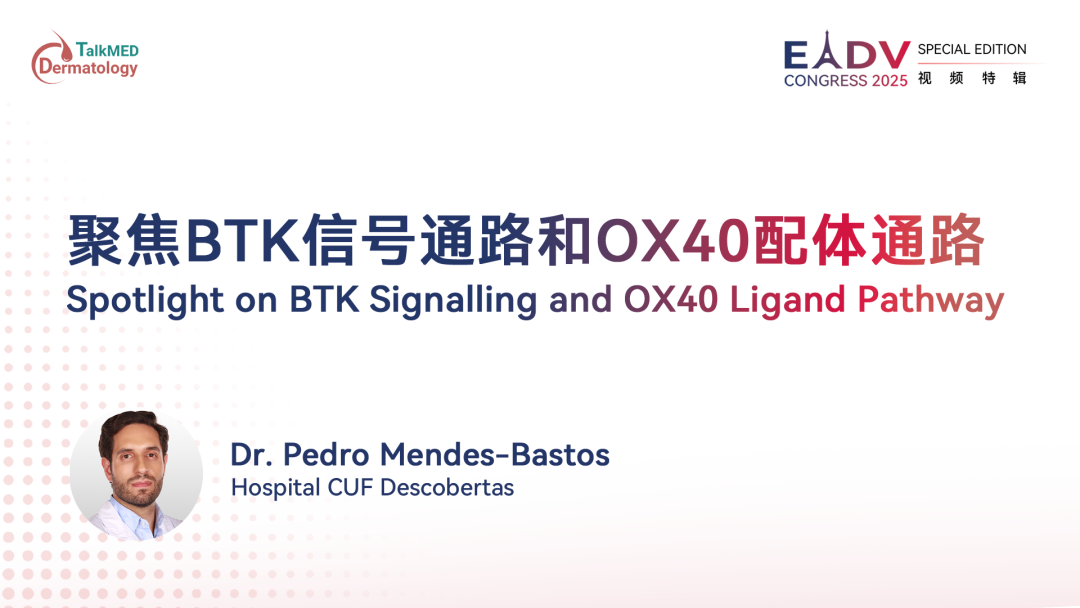
在2025年EADV巴黎大会上,葡萄牙里斯本的皮肤科医生兼首席研究员Pedro Mendes-Bastos博士分享了两个极具前景的新兴治疗靶点:BTK信号通路与OX40/OX40L通路。
BTK通路:重塑HS治疗格局的潜力
BTK(布鲁顿酪氨酸激酶)通路是皮肤病治疗领域一个令人兴奋的新靶点,目前在慢性自发性荨麻疹和化脓性汗腺炎(HS)的研发中最为深入。与当前生物制剂主要针对单一细胞因子不同,BTK抑制剂的独特价值在于其能够影响HS发病机制中涉及的多种关键细胞,包括T细胞、B细胞、巨噬细胞、中性粒细胞、成纤维细胞乃至肥大细胞。鉴于现有生物制剂对部分HS患者疗效仍不理想,这种能够同时靶向多种免疫细胞活性的新策略,有望为患者带来更优的治疗结局,相关临床数据将在未来数月至数年内陆续揭晓。
OX40/OX40L通路:开启AD疾病修饰治疗之门
另一个备受关注的靶点是OX40/OX40L通路,尤其在中重度特应性皮炎(AD)治疗中展现出巨大潜力。其吸引力源于两大核心机制:首先,它能在初始T细胞分化为TH2表型之前,通过调节T细胞与树突状细胞的相互作用,从更上游抑制免疫应答;其次,也是其最令人振奋的一点,是它可能干预记忆T细胞的生成。记忆T细胞是导致AD从急性期向慢性阶段转变并持续存在的关键。因此,靶向这一通路不仅旨在控制症状,更开启了实现疾病修饰 乃至最终治愈AD 的可能性,未来或将实现治疗间隔延长甚至诱导疾病缓解。
Bastos博士总结道,BTK与OX40/OX40L通路代表了皮肤病治疗的新前沿,它们有望彻底改变我们治疗免疫介导性皮肤病的策略。
At the EADV 2025 congress in Paris, Dr. Pedro Mendes-Bastos, a dermatologist and principal investigator from Lisbon, Portugal, shared insights on two promising emerging therapeutic targets: the BTK signaling pathway and the OX40/OX40L pathway.
BTK Pathway: Potential to Reshape HS Treatment Landscape
The BTK (Bruton's tyrosine kinase) pathway is an exciting new target in dermatology, with the most advanced clinical development in chronic spontaneous urticaria and hidradenitis suppurativa (HS). Unlike current biologics that primarily focus on single cytokines, the unique value of BTK inhibitors lies in their ability to impact multiple key cells involved in HS pathogenesis, including T cells, B cells, macrophages, neutrophils, fibroblasts, and even mast cells. Given that existing biologics still yield suboptimal results for a proportion of HS patients, this new strategy capable of simultaneously targeting the activity of various immune cells holds promise for better patient outcomes. Relevant clinical data are expected to emerge in the coming months and years.
OX40/OX40L Pathway: Opening the Door to Disease Modification in AD
Another highly anticipated target is the OX40/OX40L pathway, showing great potential particularly for moderate-to-severe atopic dermatitis (AD). Its appeal stems from two core mechanisms: Firstly, it can suppress the immune response further upstream by modulating the interaction between T cells and dendritic cells, before naïve T cells differentiate into the TH2 phenotype. Secondly, and perhaps most excitingly, is its potential to interfere with the generation of memory T cells. Memory T cells are crucial for the perpetuation of AD and its transition from acute phases to chronic disease. Therefore, targeting this pathway aims not only for symptom control but also opens the possibility of achieving disease modification and even potentially curing AD in the future, possibly leading to extended treatment intervals or the induction of treatment-free remission.
Dr. Bastos concluded that the BTK and OX40/OX40L pathways represent new frontiers in dermatological therapy, poised to revolutionize treatment strategies for immune-mediated skin diseases.