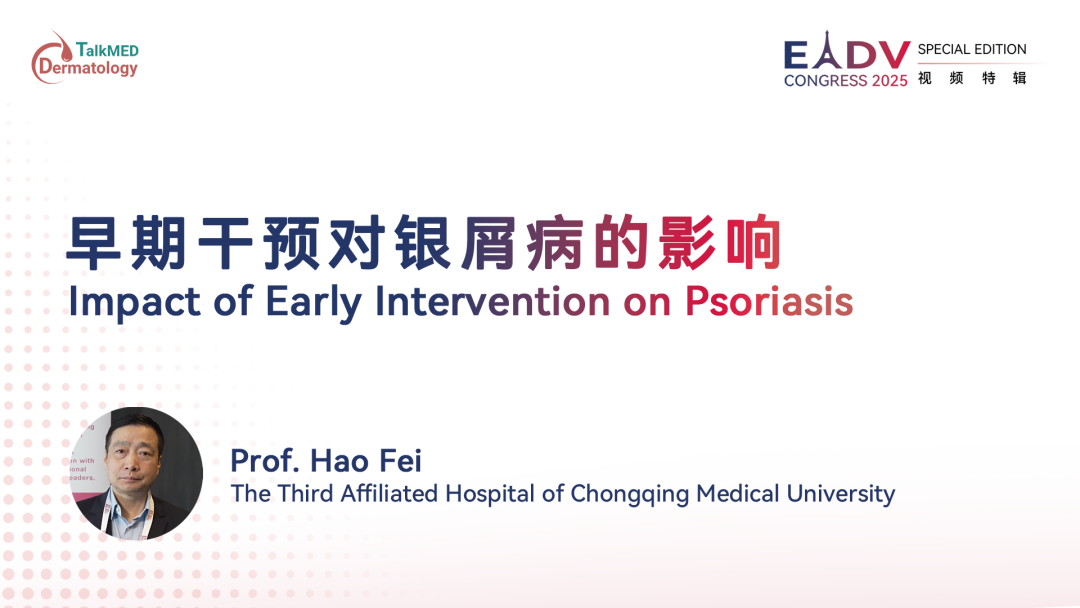
EADV 会议每年举办一次,在全球皮肤学界影响力很大,有人认为它仅次于美国的 AAD 会议。我参加过多次 EADV 会议,这些年来相关最新信息发展较快,尤为突出的是,随着分子免疫学、分子生物学研究的进展,精准靶向治疗相关内容,特别是生物制剂治疗免疫介导的炎症性疾病(IMIDs)的研究发展迅速,已成为 EADV 近几年的重要主流方向之一。同时,EADV 的学术讨论环节与中国某些研究领域相呼应,让我们深知处在好时代,能接触到优秀的生物制剂,这些生物制剂能切实帮助患者。通过 EADV 这样的年会,我们能获取诸多有益讯息,从而更好地服务患者,给予他们更多支持与帮助。
银屑病是一种反复发作的慢性炎症性疾病,也是免疫介导的炎症性皮肤病的典型代表。随着对其发病机制认识的加深,尤其是对关键细胞因子及相关受体的研究,带来了许多革命性的治疗变革,其中生物制剂靶向治疗(无论是靶向 IL-12、IL-23 还是 IL-17 等)已取得巨大成功。目前,银屑病治疗最受关注的话题是是否有更好的靶点和生物制剂选择。若这些治疗手段能让患者获得更大获益,不仅在病情较重时选择生物制剂,对于一些特殊的轻度银屑病患者,若能通过早期干预阻断病程(即疾病修饰),将具有重要意义。生物制剂进入市场以来,在银屑病治疗上的成功不仅体现在疗效好、安全性高,更重要的是能改变疾病进程,这是既往传统治疗难以达到的,不过未来仍需更多临床证据支持。我们希望不仅能简单控制症状,还能改变疾病进程,减少广泛炎症反应,避免器官受影响或出现系统性损害,为实现疾病修饰这一新治疗目标创造条件。无论是生物制剂还是小分子药物,都为炎症性皮肤病的管理提供了重要支撑,也为达成更好的治疗目标奠定了基础。
在银屑病诊断中,典型的中重度病例诊断相对容易,治疗也无太多争议,目前大家均主张优先选择生物靶向治疗,因其疗效佳、安全性高。关键问题在于症状较轻或隐秘的病例,例如出现在头皮等特殊部位的银屑病,常被误诊为脂溢性皮炎,而单纯表现为指甲改变的甲银屑病也较为常见。按照银屑病面积与严重程度指数(PASI)分类,这些头皮和指甲病变的受累面积往往低于 10%,因此通常不纳入系统治疗,尤其是生物制剂治疗。
近年来,国际银屑病协会(IPC)持续关注早期干预对银屑病的影响。头皮银屑病和甲银屑病不仅局限于特殊部位,还常因诊断困难、被忽视甚至误诊而延误干预。更重要的是,这些病变是系统性炎症在局部的表现,早期发现并干预这类疾病,能有效减缓疾病进展。头皮银屑病和甲银屑病都被认为是导致银屑病关节炎(PsA)的重要线索,此类患者进展为银屑病关节炎的风险相对更高,因此早期干预理论上具有重要意义,且一系列研究已证实其有效性。例如 SPECTREM 研究针对头皮银屑病或轻度银屑病患者,通过积极早期干预,不仅阻断了寻常银屑病本身的进程,还有效预防了银屑病关节炎的发生,同时减少了全身系统性炎症和共病的形成。另一项 GUIDE 研究是针对指甲病变的研究模式,包含多种靶向 IL-23、IL-17 的生物制剂,结果证实生物制剂能有效改善甲银屑病,既提升患者外观和生活质量,又能预防寻常银屑病向银屑病关节炎转变,甚至可能影响所有共病的发生,因此早期干预基本可实现疾病修饰状态,这也是我们追求的治疗目标。
银屑病的免疫学发病机制研究已达到较高水平,但仍有诸多问题尚未解决,例如银屑病的复发原因尚不明确。通常认为组织驻留性记忆细胞可能在复发中发挥重要作用,同时天然免疫也会影响疾病复发并成为复发的重要基础。在这种情况下,如何精准靶向炎症的特定方面,不仅有效控制斑块等可见炎症表现,还能找到能改变疾病修饰过程的靶向治疗模式,从而在无药物依赖的情况下实现疾病长期缓解,是实现疾病修饰状态的关键。未来,我们仍需开展更多相关工作。
另一方面,关于早期干预问题,许多国内专家已形成共识,但受中国医疗系统限制,目前难以让更多生物制剂惠及轻症患者。对此,我们鼓励医生在充分综合考虑各方面状况后,可选择生物制剂作为早期干预模式。同时,我们也在探索能否为中国患者找到类似的二分法方案,在让患者获益的同时,帮助他们实现疾病修饰,相关中国证据至关重要。通过对中国患者开展高水平、高质量的研究,制定符合中国国情的疾病指南,能更有效地借助高证据等级的研究方法,为中国患者提供帮助。
因此,我认为未来生物制剂治疗(无论是针对银屑病、特应性皮炎还是荨麻疹等疾病),不应仅关注一两种生物制剂,更需关注众多生物制剂乃至多靶点生物制剂治疗,以让更多患者获益。当前,分子生物学、组学研究以及相关技术平台的发展,能帮助我们将实验室研究数据转化为临床应用,切实助力患者。我坚信这一领域将取得巨大进步,患者也将获得应有的生活质量提升,未来十分值得期待。
The EADV Congress is held once a year and has great influence in the global dermatology field, with some considering it second only to the AAD Annual Meeting. I have attended the EADV Congress many times, and over the years, the latest relevant information has developed rapidly. What stands out particularly is that with the progress of research in molecular immunology and molecular biology, relevant content in the field of precision targeted therapy, especially the research on biologics for treating immune-mediated inflammatory diseases (IMIDs), is advancing rapidly and has become one of the important mainstream directions of EADV in recent years. At the same time, the academic discussion sessions of EADV correspond to certain research fields in China, making us deeply aware that we are in a good era with access to excellent biologics that can effectively help patients. Through annual conferences like EADV, we can obtain a lot of useful information, enabling us to better serve patients and provide them with more support and assistance.
Psoriasis is a chronic inflammatory disease with recurrent attacks and a typical representative of immune-mediated inflammatory skin diseases. With the deepening understanding of its pathogenesis, especially the research on key cytokines and related receptors, many revolutionary changes in treatment have been brought about. Among them, targeted biologic therapy (whether targeting IL-12, IL-23, IL-17, etc.) has achieved great success. Currently, the most concerned topics in psoriasis treatment are whether there are better targets and better biologic options. If these treatment methods can bring greater benefits to patients, not only choosing biologics when the condition is severe, but also for some patients with special mild psoriasis cases, blocking the disease course through early intervention (i.e., disease modification) will be of great significance. Since biologics entered the market, their success in psoriasis treatment is not only reflected in good efficacy and high safety, but more importantly, they can change the disease course, which is what traditional treatments in the past could hardly achieve. However, more clinical evidence is still needed in the future. We hope not only to simply control the symptoms, but also to change the disease course, reduce extensive inflammatory responses, and prevent organs from being affected or systemic damage from occurring, creating good conditions for achieving the new treatment goal of disease modification. Both biologics and small molecule therapy have played an important supporting role in the management of inflammatory skin diseases and laid the foundation for achieving better treatment goals.
In the diagnosis of psoriasis, typical moderate to severe cases are relatively easy to diagnose, and there is not much controversy in treatment. Currently, everyone advocates giving priority to targeted biologic therapy because of its good efficacy and high safety. The key issue lies in cases with mild or hidden symptoms. For example, psoriasis occurring in special parts such as the scalp is often misdiagnosed as seborrheic dermatitis, and nail psoriasis, which only shows nail changes, is also relatively common. According to the Psoriasis Area and Severity Index (PASI) classification, the involved area of these scalp and nail lesions is often less than 10%, so they are usually not included in systemic treatment, especially biologic therapy.
In recent years, the International Psoriasis Council (IPC) has continuously paid attention to the impact of early intervention on psoriasis. Scalp psoriasis and nail psoriasis are not only limited to special parts, but also often delayed in intervention due to difficulties in diagnosis, being ignored or even misdiagnosed. More importantly, these lesions are local manifestations of systemic inflammation. Early detection and intervention of such diseases can effectively slow down the progression of the disease. Both scalp psoriasis and nail psoriasis are considered important clues leading to psoriatic arthritis (PsA), and patients with such conditions have a relatively higher risk of progressing to psoriatic arthritis. Therefore, early intervention is theoretically of great significance, and a series of studies have confirmed its effectiveness. For example, the SPECTREM study targeting patients with scalp psoriasis or mild psoriasis has shown that through active early intervention, it not only blocks the progression of plaque psoriasis itself, but also effectively prevents the occurrence of psoriatic arthritis, while reducing systemic inflammation and the formation of comorbidities. Another study called GUIDE is a research model targeting nail lesions, including a variety of biologics targeting IL-23 and IL-17. The results have confirmed that biologics can effectively improve nail psoriasis, which not only enhances the appearance and quality of life of patients, but also prevents the transformation of plaque psoriasis (PsO) to psoriatic arthritis (PsA), and may even affect the occurrence of all comorbidities. Therefore, early intervention can basically achieve the state of disease modification, which is also the treatment goal we are pursuing.
The research on the immunological pathogenesis of psoriasis has reached a relatively high level, but there are still many problems to be solved. For example, the cause of psoriasis recurrence is not yet clear. It is generally believed that tissue-resident memory cells may play an important role in recurrence, and innate immunity can also affect disease recurrence and become an important basis for recurrence. In this case, how to accurately target certain aspects of inflammation, not only effectively control visible inflammatory manifestations such as plaques, but also find targeted treatment modes that can change the disease modification process, thereby achieving long-term remission of the disease without drug dependence, is the key to achieving the state of disease modification. In the future, we still need to carry out more related work.
On the other hand, regarding the issue of early intervention, many Chinese experts have reached a consensus. However, due to the limitations of China's medical system, it is currently difficult to make more biologics benefit patients with mild symptoms. In this regard, we encourage doctors to choose biologics as a mode of early intervention after fully considering various aspects. At the same time, we are also exploring whether a similar dichotomy-based scheme can be found for Chinese patients, which can help them achieve disease modification while benefiting them. Such evidence from China is crucial. By conducting high-level and high-quality research on Chinese patients and formulating disease guidelines in line with China's national conditions, we can more effectively use research methods with high evidence levels to help Chinese patients.
Therefore, I believe that in the future, biologic therapy (whether for psoriasis, atopic dermatitis, urticaria or other diseases) should not only focus on one or two biologics, but also pay more attention to a large number of biologics and even multi-target biologic therapy to benefit more patients. Currently, the development of molecular biology, omics research and related technology platforms can help us translate research data from laboratories into clinical applications, effectively assisting patients. I firmly believe that great progress will be made in this field, and patients will also obtain the improved quality of life they deserve. The future is very promising.